Key Takeaways
- ✓Infrastructure access — water, sewer, power, and roads — is the single biggest determinant of raw land value.
- ✓Proximity to employment centers drives residential land demand, which directly affects pricing.
- ✓Zoning and entitlement status can multiply land value by 2x to 5x or more for the same physical parcel.
- ✓Supply constraints from BLM land ownership around the valley create a structural floor under Las Vegas land prices.
- ✓Timing the market matters less than identifying the right fundamentals — infrastructure, zoning, and demand trajectory.
Why Two Adjacent Parcels Can Be Worth Completely Different Amounts
Drive along any major corridor in the Las Vegas Valley and you'll see a pattern that seems paradoxical: two parcels sitting next to each other, similar in size, similar in location, trading at dramatically different prices per acre. One sold for $500,000 an acre. The next one over sold for $150,000 an acre. How does that happen?
The answer lies in the factors that drive land value in Clark County — factors that are knowable and learnable, and that experienced buyers use to identify opportunities before the rest of the market catches up.
Factor 1: Infrastructure Access
Nothing affects raw land value more than infrastructure. Water, sewer, power, and road access are the foundation of any development project. A parcel with utilities at the property line is ready to develop. A parcel where utilities are a mile away requires six figures or more in extension costs before a shovel breaks ground.
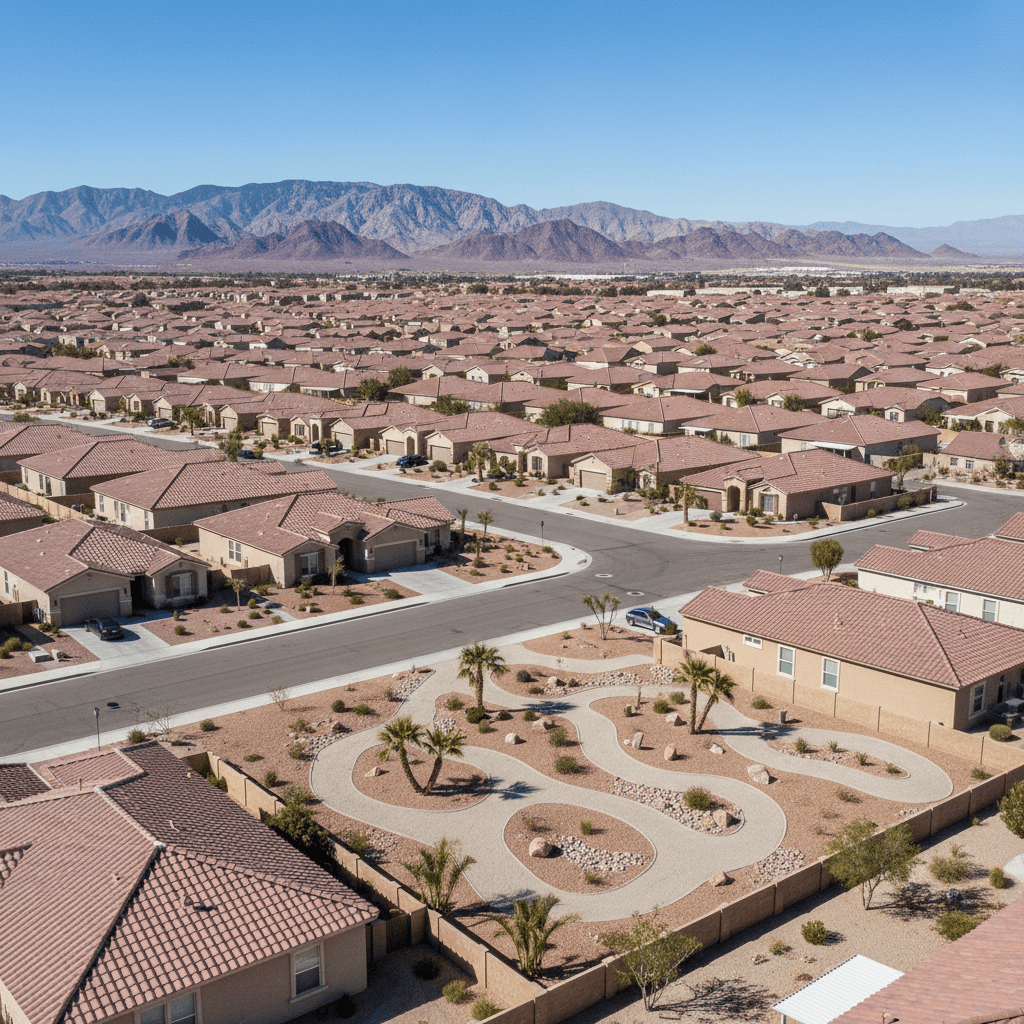
This is why land in established infill areas of Las Vegas — even small, oddly-shaped parcels — often commands strong prices. The infrastructure is already there. The hard capital costs of making the land developable have already been paid, either by prior developers or by the public sector over decades.
Conversely, this is why some of the most attractively priced land in the valley — Apex, far northwest unincorporated Clark County, the desert fringes — requires careful underwriting. The land may be cheap per acre, but the fully loaded cost of making it developable is what matters.
Factor 2: Zoning and Entitlement Status
We've covered entitlement separately, but its effect on price deserves emphasis here. A parcel zoned for high-density residential or mixed-use commercial in a strong location can be worth three to five times what the same physical parcel would be worth if it were zoned rural estates or agricultural.
The zoning designation represents the government's permission to develop for a specific use. That permission has real economic value — it determines what can be built, which determines what a finished project is worth, which works backward to determine what the land is worth to a developer.
Smart buyers learn to read zoning maps not just for what they say today, but for where they're going. Areas near a general plan designation change, or in the path of a master plan expansion, often have land that is currently priced to its existing (lower) zoning but will eventually be repriced to reflect a higher-value use.
Factor 3: Proximity to Employment
Residential land prices in the Las Vegas Valley track closely with proximity to employment centers. The resort corridor on the Strip is the valley's dominant employment center. Residential land within a reasonable commute of the Strip — Henderson, the southwest valley, Summerlin — commands stronger prices than land on the fringes that requires a 45-minute commute.
New employment drivers shift this calculus. The Raiders stadium, the Formula 1 circuit, the MSG Sphere, the emerging medical corridor in Henderson — each of these creates or reinforces demand for nearby residential and commercial land. Buyers who can anticipate where the next major employment driver will land, and who can acquire land in its path before the market prices it in, create significant value.
Factor 4: BLM Land and the Supply Constraint
One of the most important structural factors in the Las Vegas land market is rarely discussed outside industry circles: the Bureau of Land Management (BLM) owns approximately 87% of Nevada's land. Around the Las Vegas Valley specifically, BLM land creates a ring that constrains where urban development can expand.
Private land within the valley is therefore structurally scarce relative to demand. When the population grows — and Clark County has been one of the fastest-growing counties in the US for decades — that demand has to be absorbed by a finite pool of private land. This creates a structural floor under land prices that doesn't exist in markets where developable land is abundant.
The Southern Nevada Public Land Management Act (SNPLMA) governs the periodic release of BLM land into private ownership, which provides some supply relief. But the release process is slow, politically complex, and does not keep pace with demand in strong market cycles.
Factor 5: Market Timing and Capital Cycles
Land is the most illiquid asset class in real estate, and its pricing is heavily influenced by credit availability and capital flows. When lenders are aggressive and capital is cheap, land prices rise — developers can underwrite more expensive sites and still make the numbers work. When credit tightens, land prices fall fastest and recover last.
The Las Vegas land market experienced this dynamic acutely during the 2008-2012 cycle, when land values fell 60% to 80% from peak to trough in many submarkets. Buyers who acquired land at the bottom of that cycle made extraordinary returns over the following decade.
Reading the capital cycle and understanding where you are in it is a critical skill for land investors. Land bought at the top of a cycle with aggressive assumptions can take a decade to recover. Land bought at the bottom with conservative assumptions can compound dramatically.

About Parker Gibbons
Parker Gibbons is part of the PaperLotLand team. Parker Gibbons has been buying, selling, and brokering land in the Las Vegas Valley for over 15 years. He built PaperLotLand to give developers and investors a direct, off-market channel to move land — without the delays and exposure of the public MLS.
Learn more about us →Ready to Access Off-Market Land Deals?
Join our private network of developers, brokers, and investors in the Las Vegas Valley.